Showing posts with label Car Review. Show all posts

Thursday, February 16, 2012

Range Rover Sport: King of the road

If your weekday life consists of boardroom meetings hammering out mega-buck deals and the weekends are spent at your own private game farm in the Waterberg, the chances are your wheels of choice in that triple garage at your golf estate will be a Range Rover Sport.

Range Rover Sport


Since its launch in 2005 it has quickly ingrained itself as a favourite with the movers and shakers in South Africa whose pockets are lined with crisp, new R200 notes.

Why? Well not only does it draw heavily on the Land Rover pedigree for off-road adventure but also because of its sports-car like performance, handling and long list of luxury features.

No wonder its the wheels of choice for international superstars such as David "Golden Balls" Beckham, Steven Gerrard and royalty across the globe.

What is it?

The Range Rover Sport Autobiography is now the flagship for this very popular range and incorporates a number of new external and interior design elements for the 2012 version.

The name "Autobiography" - which, one must admit, is a bit unusual - is based on the opportunity it affords customers to put their own individual stamp on the vehicle when it comes to interior combinations.

A glance at its rivals in the up-market segment of SUVs shows it is right up there with the kings of the jungle.

How does it look?

Like the real deal, that's how. In the cabin you have the choice of five interior themes with a sportiness suggested by the names with which they have been christened - Estoril, Hockenheim, Le Mans, Monaco and Monza.

No fake wood panelling here; it's all genuine and tastefully used.

Its exterior stance is rather brutish and while the angles may have been rounded somewhat, it's still an imposing look. There's a new front grill and side vent while the 20-inch wheels and chrome, square tailpipes seal the deal.

Interiors of Range Rover Sport
What's it like to drive?

Press that stop/start button and the deep baritone growl making its way from the 5.0-litre supercharged engine, to those rear tailpipes, drowns out any Cape Town radio station.

Go hard with your right foot and the 2.5 tons of the RR Sport lurch forward like a startled rhino. Keep your foot flat, so the metal is touching the plush carpets, and you'll get a 0-100km/h time just over six seconds - and that's when things start to get interesting!

Once its built up a head of steam the vehicle is actually quicker between 100km/h and 160km/h than a BMW M3!

Take it off road - as we did on the 4x4 course at the Simonsig wine estate - and the vehicle channels every one of those 375kW to a different use while scrambling over boulders, through streams and down steep inclines.

Back on tar it handles surprisingly well. Through the bends you can push hard and at the slightest hint of trouble the roll stability control system kicks in by braking individual wheels if the possibility of a rollover is detected.

Any special features?

Too many to mention but what may be of interest is the permanent four-wheel drive system while the Terraine Response System offers five settings that adjust throttle response, gear changes, ride height and the like.

A dual view touch-screen is available for the first time, allowing the driver to keep an eye on the navigation system, while the passenger can enjoy a DVD. Let's not forget the ultimate Harmon Kardon Logic audio system which churns out an eye-watering 825W through 17 speakers.

Lastly, the tailgate is now powered by the push of a button while rear-seat passengers can enjoy WhiteFire wireless technology which incorporates cordless headphones.

Should you buy one?

If you have a cool R1-million-odd, to spare, why the hell not! You'll be the envy of all as you rock up at the Inanda Club on a Sunday morning for brunch.

The Specs:

Engine: 4999cc V8 Supercharged
Power: 375kW at 6000-6500rpm
Torque: 625Nm at 2500 to 5500rpm
0-100km/h: 6.2 seconds
Top speed: 225km/h
Fuel consumption: 14.9/100km (claimed combined)
CO2: 348g/km
Price: R1159300

We like:

Equally at home burning up the tar or getting dirty off road.

We don't like:

Around town, driving will be mighty expensive. Expect it to guzzle more than 20 l/100km.

Source: Times Live

Tuesday, January 31, 2012

Range Rover's Evoque surprisingly superb: MSN

2012 Range Rover Evoque


Hey, Land Rover isn’t following the rules!

You know, the rules for concept cars: a car maker rolls out a rakish design concept that sets hearts aflutter, then just as customers are prepared to rush into showrooms, checkbooks in hand, they pull a bait-and-switch by introducing a production model that is disappointingly prosaic by comparison.

Heads hanging, dejected customers trudge home without the cool concept car they had imagined themselves driving.

Well, Land Rover didn’t do this when it forged the Range Rover Evoque Coupe from the LRX concept vehicle that wowed auto show-goers who never anticipated they’d be in position to buy something just like it in short order.

Land Rover’s daring has earned the Evoque an avalanche of accolades, such as North American Truck of the Year, Motor Trend SUV of the Year, an Automobile magazine All-Star award, AutoWeek’s “Best of the Best,” Car Design of the Year, Scottish Truck of the Year, and so on.

Why? It isn’t every day that you can go to a dealer and buy a new car that swivels heads like you were driving with Scarlett Johansson standing through the sunroof with a wardrobe malfunction.

Sure, there are garish overreaches out there, like the Kia Soul and Nissan Cube. But they draw attention because of their unusual styling.

Of course, Range Rovers are already fashionable, so having a stylishly sporty compact head-turner will only accrue still more prestige to the brand, even though this new model has a lower price tag than the Range Rover Sport or the “real” Range Rover.

Land Rover’s heritage, of course, is of boxy off-roaders used to document endangered species in Africa for American television viewers, and of the later Range Rover, which is the unofficial vehicle of the horsey set. A line plotted from those two points does not arrive at the smoke-machine-and-strobe-lights fantasy that is the Evoque.
That’s fine. The Evoque isn’t meant for Land Rover devotees. It’s meant to bring in buyers who may want a little more elbow room or capability than they get in their current Mini Cooper or Audi TT. And a four-door variant might attract people currently driving a 3-series sedan or wagon. Maybe even the odd compact SUV owner who wants to upgrade in style but not in size.

The wheels are “only” 20 inches, but they look even bigger with the Evoque’s size and proportions. The squinty headlights are really high-intensity-discharge xenon lamps like on most premium cars, but bystanders would happily believe they are lasers.
The car I tested had the optional $650 white contrast roof. It’s probably striking on Evoques finished in bold primary colors, but it doesn’t contrast with the Stornoway Grey paint of our car. My wife thought it looked like the dealer had left the protective vinyl shrink wrap on the roof. I’d keep the cap and change the paint color to red.

Avoid scratching that paint by seeing everything around the Evoque with the five-camera surround view on the infotainment screen.

The dramatic styling is backed by a 240-hp turbocharged, 2.0-liter our-cylinder engine known elsewhere as a Ford Ecoboost.

As a sporty urban runabout, the Evoque excels, with taut, responsive handling unlike that of any previous Land Rover product. The Evoque uses magnetically adjustable shocks like those seen on Ferraris, Corvettes and Cadillacs to adjust between comfort and control on the fly.

Off road, well, it is still a Land Rover product, so break out your bush attire and head to the savanna to track endangered big cats. Or, with the Evoque’s adaptability, put on your best attire and head to Savannah, Ga., to sip seet tea on the veranda.

Here’s one aggravation though: The door hinges and seals seem unusually stiff, making it difficult to close the doors without slamming them. Maybe it’s the sealing needed for river fording that causes the problem, but if so I didn’t notice the issue with the full-fledged, $100,000 Range Rover I also tested recently.

With the coupe’s two doors at least the driver has control over closing half the car’s doors, leaving only one person to be reminded to slam the door. Even with large doors, the coupe still doesn’t have a wide enough opening to ease the difficult access to the unexpectedly spacious back seat.

The headroom in the rear of the Evoque is amazing, and other measures are also good, though legroom benefits from the low, unsupportive seat bottom that can leave back seaters feeling like they are perched on kids’ desks on back-to-school night.

The coupe packs style at the cost of some practicality, though the four-door version preserves a decent chunk of that style with a much bigger serving of utility. The Evoque seems positioned, with its turbo four-cylinder engine, to tout fuel efficiency as an advantage over competitors, but in a week of mixed driving I saw 18.5 mpg, a half-tick above the EPA city rating of 18 mpg and not in the same area code as the highway rating of 28 mpg.

Such may be the cost of the Evoque’s max-capability all-wheel-drive system, which is unmatched in the segment in off-road, bad-weather capability.

Ultimately, however, while extreme traction is Land Rover’s hallmark, the Evoque will win hearts with its dramatic styling and will probably keep them with its comfortable ride. The Evoque’s ability to wade into the valet line at the Ritz probably trumps its ability to wade into rivers.

There is no doubt that the Evoque is the most exciting entry in the premium compact crossover segment and may be the production model truest to its design concept since the Pontiac Solstice.

Vital statistics: 2012 Land Rover Range Rover Evoque Coupe

Base price: $44,995 (including shipping)
Price as tested: $58,370
EPA fuel economy: 18 mpg city, 28 mpg highway.
Pros: Incredible traffic-stopping styling, honest-to-goodness Land Rover off-road capability, surprising cabin space.
Cons: $58,000 sticker price, 18 mpg is not impressive for a four-cylinder compact crossover.
Verdict: Exclusive fun.
Standard equipment: 240-hp. 2.0-liter turbocharged I-4, 6-speed automatic transmission, all-wheel drive with adjustable Terrain Response System, panoramic sunroof.
Major options: 20-inch sparkle finish wheels, surround camera system, navigation with voice control, xenon headlights, 825-watt audio system.
Safety equipment: front and side air bags, air curtain, driver’s knee air bag, electronic stability control, roll stability control, hill descent control, traction control, anti-lock brakes.

Source: The Bottom Line on msnbc.com

Monday, December 19, 2011

Test Drive: 2012 Range Rover Evoque Pure

2012 Range Rover Evoque Pure


2012 Range Rover Evoque Pure's Cabin
The cabin is elegant and well crafted, using the classic Range Rover wide centre console that rises over the contrasting horizontal elements of the dash. The controls are large, logical and glove friendly, and the eight-inch touch screen is clear and intuitive – obviously an evolution of the aging system seen in all the other LR and Jaguar products. Time for the rest to play catch up, as this one is much better.

The Jaguar/Land Rover signature rotary shift knob that rises from the console on start up is as functional as it is unique. Also on the console are buttons for the Terrain Response. The four settings – General/ Grass Gravel Snow/ Mud and Ruts/ Sand – optimize the AWD, throttle response, stability control and traction control for the selected conditions. Hill start assist and descent control are also included.

The front seats with their suede-like inserts are excellent – grippy and supportive yet comfortable for the long haul.

On the road the Evoque has a taut, athletic feel. Throttle response is quick (although jumpy at times) and this pressurized 2.0-litre four banger feels a lot stronger to me than its quoted output. Put your foot in it and the Evoque really charges. The six-speed auto works well although response to the paddles is not particularly prompt. The brakes feel strong and the hydraulic steering is alert and direct.

Unlike the LR2, the Evoque shows a real appetite for the corners, but you pay the price in ride quality. It’s not harsh, just firm, which might become an issue if Yolanda Yoga spends the majority of her time on crappy urban (Toronto) streets, ferrying the kids, scurrying to pilates and double-parking in front of Hazelton Lanes.

On the highway, the Evoque tracks beautifully and the cabin noise is well suppressed; all the better for grooving on that sound system.

Transport Canada cites 11.4 L/100 km city and 7.1 L/100 km highway, with 9.5 L/100 km combined. In comparison, the BMW X3 (base $46,000) with its creamy 300-hp turbo six and eight-speed auto returns 11.1 / 7.7 / 9.6 L/100 km – pretty much a wash.

Perhaps the Evoque’s closest competitor is the new BMW X1, another compact premium AWD crossover motivated by a 2.0-litre turbo four. On paper they are remarkably similar, with nearly identical power outputs and luggage capacity, although the X1 is lighter, quicker, more frugal at 10.2 L/100 km city and 6.5 L/100 km highway, and at it bows at $38,500.


The biggest difference lies in the fact that the X1 is a tall car, whereas the Evoque is a bona fide boonie-basher that will tow your jet ski and wade in water up to 500 cm in depth. And there’s certainly no contest in the looks department.

This dramatic newcomer is the first all-new vehicle from Range Rover since Tata purchased Jaguar/LR in 2008. Having just been named Motor Trend Sport Utility Vehicle of the Year, it’s appears the Evoque is off to a good start.

Pricing: 2012 Range Rover Evoque Pure
  • Base price: $46,995
  • Options: $2,700 (City Package (powered tailgate, chrome entry and tailgate strips, 19-inch sparkle finish alloys, Sirius satellite radio, park assist, rear view camera with hitch assist))
  • A/C tax: $100
  • Freight: $1,270
  • Price as tested: $51,065

  • Source: Autos CA

    Thursday, December 8, 2011

    Review: New Jaguar XF 2.2 turbo diesel

    Jaguar XF 2.2 D


    Looking at the Jaguar XF's speedo showing 110kmh doesn't compute when you glance across at the tacho registering a scant 1300rpm. But that's what the new turbo diesel four pot Jaguar XF 2.2 does on the highway. It cruises just above engine idle speed.

    FRUGAL

    Some cars would be humming away at 3000+rpm sucking fuel like there's no tomorrow. Not the XF 2.2 which is claimed to be capable of 5.4-litres/100km. We couldn't get that but saw a reliable 6.5-litres/100km with mixed driving.

    Doesn't matter how you cut it, this sort of fuel economy from a 1700kg medium large luxury sedan car is damn impressive. Needless to say, the XF 2.2 is the most economical Jag ever made.

    PERFORMANCE

    And it goes pretty well too thanks to the 2.2-litre turbo-diesel engine made by PSA in Europe. PSA is an offshoot of Peugeot and supplies engines to BMW and Mini.

    This engine is also in the Land Rover Freelander and new Range Rover Evoque. It's a good and capable of delivering a handy 140kW of power and 450Nm of torque.

    Not as good as the Benz 2.1 turbo diesel rated at 150kW/500Nm but enough not to notice. There's an eight-speed auto driving the rear wheels with seamless precision and paddle shift if you want a sporty drive.

    VALUE

    The entry level XF Luxury hits the showroom at $78,900 plus on roads but start ticking the boxes for options and up it goes - rapidly. We drove the Premium Luxury model at $86,100 with more kit but you can still crank it up. Happy with the Luxury?

    It gets you leather, Bluetooth phone and audio streaming, automatic dual climate control, air filtration, auto bixenon headlights, LEDs front and rear, a seven inch colour info ' touch screen and multi' steering wheel controls.

    Other goodies include an electric park brake, pop up dash vents, pop up gear selector knob and rain sensing wipers. The XF was revised recently inside and out but still looks like.....an XF with XJ headlights.

    THE DRIVE

    The 2.2 is great to drive and you wouldn't know it was a four cylinder diesel except under hard acceleration because of low noise and vibration. It hauls the big sedan around with aplomb. Ride quality is supple and controlled and overall drive feel is positive.

    DOWN SIDE

    But it only gets a four star crash rating, has a space saver spare and there is some lag off idle when you punch the accelerator - waiting, waiting, whoosh.

    The test vehicle developed an annoying frequency vibration in the front door area which would drive an owner nuts. We didn't `get' the engine stop/start system that seemed to have its own agenda. The boot opening is narrow.

    VERDICT

    It's up against some classy opposition in the BMW 520d, Benz E220CDi and Audi A6 2.0 front wheel drive - all around the same money. Hard call.....


    JAGUAR XF 2.2L TURBO DIESEL
    • Prices: $78,900 (Luxury 2.2 turbodiesel), $86,100 (Premium Luxury 2.2 diesel), $84,990 (driveaway Luxury 2.2 white or black)
    • Warranty: 3 year/100,000 km
    • Service: 26,000km (diesel), 24,000km (petrol)
    • Safety: 4-star NCAP, 6 airbags, ABS, traction control, stability control
    • Engine: 5.4L litre, 4-cylinder turbodiesel, 140kW/450Nm
    • Transmission: 8-speed automatic, RWD
    • Thirst: 5.4 l/100km
    • CO2: 149g/km
    • Dimensions: 4961mm (L);1877mm (W);1460mm (H);2909mm(WB)

    Source: Cars Guide

    Tuesday, December 6, 2011

    2012 Tata Nano: A detailed preview

    You do not need to step inside the 2012 Tata Nano to know that the vehicle has been given a complete makeover. The multiple color range that it has been provided with including unique colors, like Rouge Red and Papaya Orange, makes this statement as soon as you take a look at the vehicle.

    Tata Nano 2012


    The Exteriors:

    Though the car has been launched as a low-budget hatchback, Tata Motors has not shied away from giving a stylish look to the 2012 Tata Nano. The bonnet, though small, gives a petite appearance to the car. However, other than the additional eight colors that the vehicle comes in, it is hard to identify any other features within the car exterior that are strikingly different from the previous model. The only major additions that have been provided to the exteriors of the vehicle is an additional rear-view mirror on the passenger side, which indeed is a sensible and essential addition. Also, the top end LX model has been provided with plastic wheel-caps.

    The Interiors:

    If you were getting a bit disheartened looking at the exteriors and thinking that it’s the same vehicle with minor adjustments, just open the door of the vehicle and the refreshing change provided to the interiors gives you the feel of stepping into an all-new car, altogether. It really seems that the authorities at Tata Motors have indeed been listening to their customers. The manufacturer has definitely taken a lot of pains in livening up the interiors. The LX model has been given a beige-colored dashboard with a central console and the gear knobs have been given a silver finish. With the seat fabric also being provided in beige, the cabin gets a feel that we all desired for. The standard version has been provided with graphite interior that exudes a lot of freshness. Similarly black is the chosen colour as far as the interior of the CX model is concerned. The two-toned door pads with deeper pockets are also a significant notch up from the initial model that had been introduced.

    The other comfort feature that was definitely required, and hence is being appreciated greatly, is the provision of adjustable headrests in the front seats. Though these headrests have restricted movement, yet the development is significant as the earlier model just had a one-piece seat. The front seats also are more supportive to their occupants. As we move to the rear, we are again reminded of the huge space the Nano has packed inside, almost a size greater than all competitive budget hatchbacks. Comfort issues of the rear seat passengers have also been addressed with the height of the seat back being raised to provide better support to the shoulders.


    Power and Mileage along with Driving Comfort:

    The manufacturer has definitely put in work on the 624cc engine. Not only is it more fuel-efficient, the power has also been increased to 37BHp (the previous model was at 35BHp). Torque has also been raised to 5.2kgm. The Nano retains its city driving aspect and now offers increased fuel-efficiency of 25.4 km/liter (23.6km/liter was provided by the erstwhile model). The overall driving comfort have also been refined further as you experience less shocks while driving.

    A complaint we always held while driving the erstwhile model of the Tata Nano was the heaviness of the steering when operating at a slow speed. The suspension has been definitely given a fair revision and the effect seems noticeable with the steering being a little lighter. However, some degree of effort is still required on the steering, particularly when parking the vehicle. Power steering is not something that one might see in the very near future. This has been addressed to a certain extent, though, with the tight-turning circle of the Nano, that enables you to weave through city traffic. The vehicle also has improved stability with the anti-roll bar provided at the front, doing its job well.

    Pricing:

    The best news among all these however is the fact that all the updates provided have not been accompanied with a corresponding increase in price. Ex-showroom pricing of Nano 2012 for Delhi is:

    Standard Model - Rs.1.4 Lakh
    CX Model - Rs.1.7 Lakh
    LX Model - Rs.1.96 Lakh

    Source:Indian Drives

    Monday, October 24, 2011

    2012 Jaguar XF 2.2 Diesel Review: The Motor Report

    New Jaguar XF 2.2L Diesel


    Jaguar XF 2.2 Diesel Review: Highlights

    What’s Hot: XJ looks, punchy diesel torque, sweet fuel-saving technology
    What’s Not: Pricey options, not keen on the 'space-saver' spare
    X-Factor: The stunning powertrain is going to win lots of friends
    Vehicle Style: Luxury Sporting Sedan
    Price: $78,900 (plus on-roads)
    Engine: 2.2-litre four-cylinder turbodiesel
    Power: 140kW@3500rpm
    Torque: 450Nm@1200rpm
    Transmission: 8-speed automatic
    Fuel Economy (claimed): 5.4 l/100km
    Fuel Economy (tested): 7.1 l/100km

    OVERVIEW

    The MY12 Jaguar range arrives with a raft of subtle design and performance changes, and two big additions to the brand: the bombastic XKR-S performance coupe, and the frugal XF 2.2-litre diesel sedan.

    Oddly enough, it's that 2.2 diesel that has most eyebrows raised. With stop-start technology, and mated to an eight-speed automatic gearbox, it's Jaguar's first small-capacity diesel – in fact the smallest engine the Brit manufacturer has ever made.

    Small it might be, but there's no shortage of torque on tap. It hauls 1700kg of luxury Jag around with total ease. Setting a new entry-level price, it's this model that will be the big seller.

    INTERIOR

    Quality: Pardon the pun, but Jag has made a huge leap in quality with the XF range. The ‘base’ XF oiler is no exception.

    Trim of double-stitched leather with alcantara seat-inserts (for added grip) doubles with soft-touch surfaces and smart dials. The retina-roasting chrome of the previous car’s centre console, which reflected sunlight uncomfortably into the driver’s eyes, is now in a soft brushed silver.
    Only the wood trim-panels on the test car, which sound and feel synthetic, dulled what is a quality cabin.

    Comfort: Standard four-way seat-adjustment on both front seats makes getting settled a breeze. The alcantara and leather trim grips the body and cossets the hips and shoulders for lateral support in both rows.
    Our test car’s 'six/six-way' adjustable seats were a $440 option; lumbar adjustment is also in the next spec of seat.

    Equipment: The XF now gets the lovely swoopy headlights of the XJ, with the best daytime running-light design going around – and shaped in a 'J' (of all things).

    In base “Luxury” trim it comes with leather, multi-function steering wheel with paddles, and a seven-inch colour touch-screen for the multimedia interface.

    This includes a 30GB hard drive, iPod and Bluetooth connectivity, and an excellent speaker system.
    But as with any base-level car, the options list is rather long and pricey. Our “Luxury” test vehicle, sitting below a “Premium Luxury” spec, featured front parking sensors and a rear camera ($1,390), a mirror pack ($1,570), 'six/six-way' seats ($440), split rear seat ($1,000), carpet mats ($350), keyless entry ($950), 18" Vela alloys ($2,490), Rosewood veneer ($320), metallic paint ($2,650), sat-nav ($2,495) and a sunroof ($3,920), making it a $102,565 car.

    Storage: The Jaguar bests Audi and BMW rivals with a narrow but deep glovebox, cupholders, cubbies and deep door-pockets.

    The boot is very large but unfortunately, with the batteries relocated to the boot, the floor of the Jag hides only a skinny spacesaver spare.


    ON THE ROAD

    Driveability: Punchy and powerful, the 2.2 diesel hardly feels like a four-cylinder.

    In fact, it’s easy to forget it’s a diesel. The power and torque curve is very precise, with power kicking in as torque wanes, making a very smooth powerband. Its slick operation is underpinned by not six, but eight speeds, in the ZF sports auto.

    It takes a little getting used to. Using the paddles around Mt Tambourine on the Queensland/NSW border, the 'usual' two or three taps to change down suddenly becomes four or five.

    But the gearbox is super intelligent, allowing gear stacking with multiple hits of the down paddle, and even dropping down a gear during heavy braking to utilise engine compression.

    It’s a genuine performance package, this four-pot oiler, with stunning throttle response, rear-drive accuracy and light-footed ability despite its 1700kg-plus heft.

    Refinement: It is easy to forget you are in a diesel such is the XF's on-road refinement. Only when the stop-start activates – when you're first listening for it – do you notice at all that it’s a diesel.

    The stop-start tech is a first for jag and only available on the 2.2 litre model. The battery, located in the boot, regenerates during the drive to always be on hand (for instant start-up, with a single revolution of the engine). The combined fuel sip is a miniscule 5.4 l/100km.

    Suspension: The suspension is just short of sublime, with long travel and excellent rebound and bump control (despite the car’s weight and size).

    It’s hard to set off the traction/stability control, even over upsetting dips and cambered corners.

    Braking: The brakes too are excellent, without fade, though the pedal feel and travel is a bit remote.

    SAFETY

    Safety features: Front, side and curtain airbags, front load limiter/pretensioner seatbelts, rear pretensioner seatbelts, front active headrests, Brake Assist, Electronic Brakeforce Distribution, Traction Control, Electronic Stability Control,

    WARRANTY AND SERVICING

    Warranty: Three year with roadside assist
    Service costs: Servicing every 26,000km!


    TMR VERDICT | OVERALL

    If it seems this review is glowing, it's because the XF diesel absolutely shines.

    For $84,990 on road, and with a host of options to tailor the car to suit, it sinks top-of-the-line HSVs and FPVs.

    Of course, it's more the big three German competitors that are in the Jag’s crosshairs; in particular, their sub-$90k diesel sporting sedans. Jaguar's new XF diesel is their match.

    In Europe, the 2.2 makes up almost half of XF sales. If you're shopping in this part of the luxury segment, we'd recommend a close look at this very good new car from Jaguar, the XF diesel 2.2.

    Source: The Motor Report

    Friday, October 14, 2011

    New Tata Vista review: Business Line

    New Tata Vista Refresh


    The Tata Indica has evolved over the years to become what it is today. The Vista that was born in 2008 was a better car, but the new Indica Vista introduced earlier this year is a big step in the right direction. Compared to the predecessor, the changes to the new one finally arms it to take on the others in the premium hatch category.

    The Design


    The changes to the all new Vista are very evident, though the design is all-together very familiar. It is a classic example of what the right choice of trim can do a car's appeal. Inherently, the design lines are all carry forwards, but within that the changes help the new Indica Vista bloom and suddenly there is a lot of premiumness that radiates from the car.


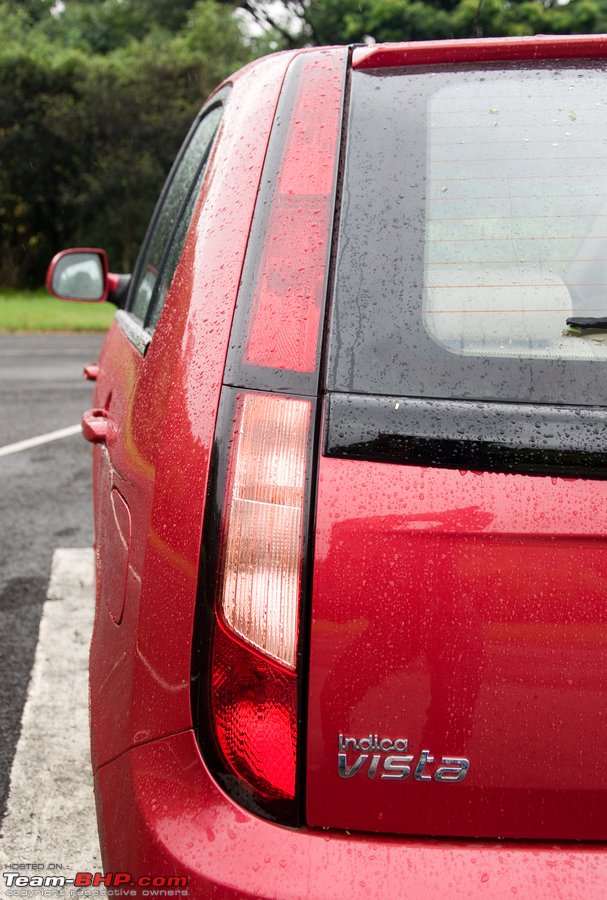
    At the front of the new Vista, the elongated, semi-circular headlamps now feature the same three-barrelled reflector design that the Tata Manza has. In fact, there are more borrowings from the Manza like the chrome-lipped, four-slatted bonnet grille. There are a lot of chrome elements all around, re-confirming that we Indians are still madly in love with this finish. The grille is entirely coated with chrome and there are chrome strips on the front bumper, the door protection rub-strips, on the door handles and surrounding the front fog lamps. At the rear, the most prominent new addition in the Indica Vista is a new black, mirror-polished tailgate garnish at the bottom of the rear glass. An intelligent rear wiper and demister and some minor alterations to the rear bumper are the other changes at the rear.

    The shut lines in the new Indica Vista are tight as was the case with the predecessor too. Panel gaps are uniform and well within limits that are found amongst similar cars in the segment. Quality of materials used and the overall finish quality of the features in the new Vista take the exterior appeal to a new level never seen before in an Indica.


    The Interiors


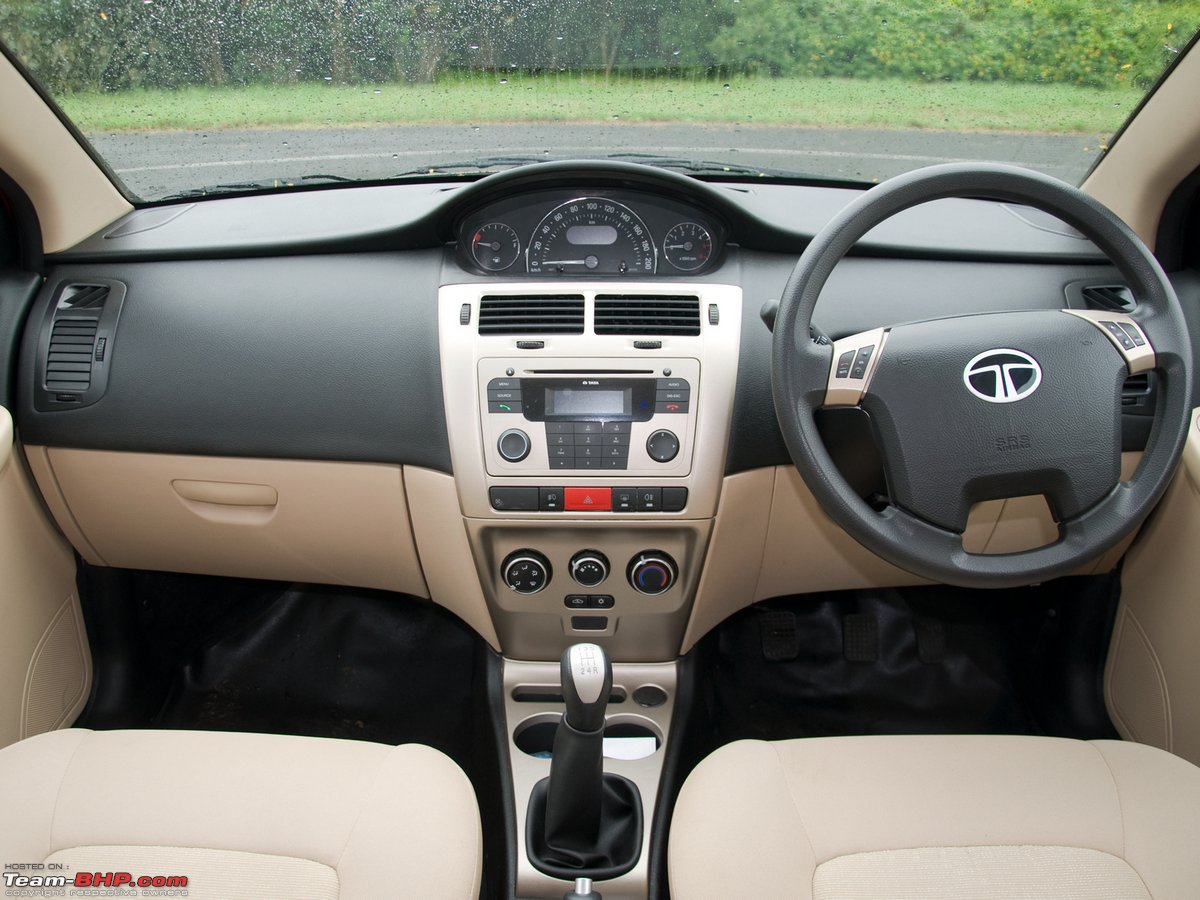
    Step in and you will find the same goes for the interior of the new Indica Vista too. There is sea change in the quality of the interior, with much of the change evident in just the quality of the material used, for example in the dashboard plastic, the plusher seat fabric and the knobs and controls.

    Steering mounted audio controls, under seat tray, electrically adjustable door mirrors, height adjustable driver's seat and an illuminated key-hole ring to make it easy to find in the dark are some of the features in the new Indica Vista.

    The interior also gets soft-finished dashboard plastic and a new Sahara Beige and Ebony Black dual-tone colour theme. The instrument cluster continues to be centrally located on top of the centre stack on the dash. Previous users will be familiar and possibly even like the location of the dials, but new buyers might take a while to get used to it.

    Electric HVAC controls and nicely shaped and bolstered seats were a treat in the new Vista. Rear seat comfort, including the shoulder space and legroom are still excellent compared to many cars in this segment. Safety also gets a leg up in the new Vista with dual front airbags and ABS with EBD being available in the top variants. Keyless entry and an engine immobiliser are the other additions.


    The Drive


    On the road, the new Indica Vista seems to behave with new found confidence. There is no hesitancy or delay in braking and at first the reasons are not apparent as much as the feeling of strength is. The previous Vista also felt like a lumbering hulk, with the power train sounding like it was straining hard to pull the car away quickly. The effect was very similar when you tried to stop in a hurry, with the car lurching and coming to a stop after a nose dive. But this is almost gone in the new Vista.

    The change agents here are the larger brake booster and the much improved clutch. Braking performance has clearly improved and the new clutch that keeps the same power trains engaged has contributed significantly to improving the drivability of the new Vista.

    More progressive in response, pliant during use and quick to engage, the new clutch in the Vista managed to leave me with a happy left foot. There is still room for improvement though.

    I test drove the new Indica Vista Quadrajet, fitted with the same 4-cylinder, common rail diesel engine that is also offered with the Fiat Punto, Suzuki Swift DDiS and a couple of other cars from the three brands.
    Developing a peak output of 75 PS and peak torque of 190Nm, this engine, like the other three on offer – the Safire 65 and Safire 90 petrol mills and the other Tata turbocharged intercooled TDI diesel engine – felt the same. All the engines have been carried forward and offer the same intrinsic performance.

    The clutch has made the difference and changed the way the new Vista feels to drive. It is clearly more oriented towards its target audience – individual buyers. In cabin noise levels are also lower in the new Vista, though again there is room for further improvement.

    Talking about comfort, Tata engineers also seem to have reworked the suspension of the new Vista, making it more pliant and softer. The ride quality is more accommodating over bad roads and there is a lot of that now after the monsoon. The ride is not exactly wallowy, but there is a lot that gets soaked up and only some really big potholes leave the Vista ruffled. However, some of the retuning to the suspension has meant that the driving dynamics have had to be compromised.

    I felt a lot of body roll when I tested the new Vista on windy roads, quick overtakes and through tight corners, but it doesn't interfere much during city driving.

    The new Indica Vista's claimed fuel efficiency continues to be 22.3 kmpl for the Quadrajet and 19.4 kmpl for the TDI (which is a BS3 version only) and for the petrol engines - Safire65 it is 16.7 kmpl and 13.7 kmpl for the Safire90.

    Armed to be as loaded as, yet priced just lower than the Suzuki Swift, the new Tata Indica Vista wants to be seen as the better car. Surely, there is a lot going for it in the car itself. This new version just could be the image changer.

    Source: The Hindu

    Land Rover’s Dashing $44,000 Evoque Takes on BMW, Lexus: Bloomberg

    The 2012 Range Rover Evoque seats five and gets 28 miles per gallon highway, 18 city.


    You’ve never considered owning a Land Rover? Clearly you don’t live in the Australian outback or have a Hollywood entourage to cart around between house parties in the Hills. Maybe you can’t rationalize the 12 miles per gallon in the city.

    You might have a BMW or Lexus SUV, but until now you’ve been safe from the siren call of the Gaydon, U.K.-based brand.

    Well, take a look at the new Range Rover Evoque.

    The 2012 Range Rover Evoque starts at $44,000, and goes to $59,820 for a fully-loaded Dynamic Coupe in "Firenze red."


    It’s a dazzlingly designed Trojan horse, aimed squarely at owners of the X3, RX and Audi Q5, an anti-box that looks like a crossover, while retaining a dash of Land Rover’s legendary off- road capability.

    Old-school Land Rover drivers who actually do drive in the bush will hate it.

    There’s a long-held perception that a Land Rover is an impractical purchase. I’m thinking of buying a vintage Range Rover and have been told I should get a second “parts car” too -- to save money as mechanical bits go, invariably, wrong.

    That’s why the brand so desperately needs a car like the Evoque, which seats five and gets 28 miles per gallon highway, 18 city. Those aren’t hybrid-worthy numbers by any means, but they’re easily more sensical than that $95,000 Range Rover Supercharged with 510 horsepower.

    The Evoque’s starting price of $44,000 is also more accessible for urbanites aspiring to get back to nature, or, at least, reaching suburbia’s big-box stores.

    Super Charge

    Still, one of the models I tested (and predictably liked best), was a fully loaded Dynamic Coupe in Firenze red, that came to $59,820. Even a German luxury carmaker might consider that a ballsy up-charge.

    The Evoque is coming into dealerships now. Aggressively styled without seeming weird, the designers have found the just- right proportions of sports-car zippiness and SUV brashness. The Evoque’s rising belt-line and down-sloping roof scrunch the rear windows, creating a sense of tension and surprise. Whatever the body color, the optional blacked-out roof is the sharpest look.

    Heritage hasn’t been completely ignored. The clamshell hood is old school, and the grill is a natural progression of the current lineup’s face.

    The Evoque comes as either a five-door or three-door model, which the company calls a coupe. The latter is $1,000 pricier and way cooler. The five-door is more practical. Even so, they’re roughly the same size, 14.3 feet long and 5.3 feet high -- diminutive by Land Rover standards.

    Glass Lid

    The inside is distinctly carlike. There’s plenty of room, but it’s more like the space of a midsize sedan than a fat SUV. The entire roof is glass, from door frame to door frame.

    Because of the rake of the top, you actually get little sense of that panoramic glass from the front seats, but in the rear it’s simply spectacular. You can see the entire world back there. I’d like to spend a whole day being chauffeured around Manhattan, checking out the buildings. Passengers may actually start calling dibs for the back.

    One of the most elemental shifts is the new engine, a four- cylinder with 240 horsepower, 251 pound-feet of torque. It is turbocharged and direct-injected.

    I drove both Evoque body styles and several trim levels around Vancouver, Canada, and in the woods outside of Whistler. Rotating among several vehicles, my favorite, by far, was that coupe with the “dynamic” package. Aesthetically, it has a more aggressive front and rear than the other two trim levels, Pure and Prestige.

    Magnetic Appeal

    Mechanically, it included the optional, $1,250 adaptive dynamics feature, which alters the stiffness of the suspension using magnetic fields. This technology showed up on General Motors products years ago, and it’s definitely worth it, improving handling and ride quality.

    The Evoque drives nearly as nicely on the road as any crossover or small SUV on the market, except for the latest- generation BMW X3. The X3 is faster, more fluid and outright more capable on-road; nearly as good as the 3 Series sedan.

    The Evoque’s steering is crisp and has a nice weight. The all-wheel-drive keeps it from feeling skittish even on roads dotted with gravel. I leaned hard into a number of sharp corners and never had reason to regret it. It helps that the Evoque weighs just under 4,000 pounds.

    For all that style and on-road comfort, you’ve got to give something, and in this case it’s a measure of off-road prowess. This truly won’t bother the average driver, as the Evoque runs along badly-rutted dirt roads nicely. It’ll even wade through a heap of muddy water.

    Nasty Scrape

    But hard-core off roaders will find, to their horror, the Evoque has no low range, the type of low-end gearing needed for truly serious terrain. The underside clearance is more than eight inches, but I heard at least one nasty scrape while cresting over a wide rock. Take this to your local Jeep Jamboree and they’d giggle at you.

    That’s okay. If you’re hitting the hills in the Evoque, it’ll more likely be the ones on Mulholland, on your way to a truly fabulous house party.


    The 2012 Range Rover Evoque Coupe at a Glance


    Engine: 2.0-liter four-cylinder with 240 horsepower and 251 pound-feet of torque.
    Transmission: Six-speed automatic.
    Speed: 0 to 60 mph in 7.1 seconds.
    Gas mileage per gallon: 28 highway, 18 city.
    Price as tested: $59,820
    Best feature: Stylish appearance and that massive panoramic sunroof.
    Worst feature: No low-range off-road.
    Target buyer: The small-SUV shopper who wants cutting-edge looks and acceptable mpg.

    Source: Bloomberg

    Thursday, October 13, 2011

    Jaguar XF 2.2 Diesel Review: CarAdvice

    Jaguar XF 2.2 Diesel 2.2-litre four-cylinder diesel with Intelligent Stop/Start and 8-speed ZF automatic transmission 140kW/450Nm:
    Jaguar XF 2.2 Diesel Luxury: $78,900 (Manufacturer’s List Price)
    Jaguar XF 2.2 Diesel Premium Luxury: $86,100 (Manufacturer’s List Price)


    Sir William Lyons, Jaguar founder, said from day one that his company was in the business of making ‘Beautiful Fast Cars’ and that’s pretty much what they’ve been doing for years, give or take the odd hiccup.

    Ian Callum, Jaguar’s Director of Design, has essentially transformed the iconic British carmaker into a design powerhouse that is fast becoming the envy of the big three German luxury automotive brands.

    So it might come as somewhat of a surprise to some that Jaguar has just released a 2.2-litre diesel in the mid-size XF model line-up.

    I know what you’re thinking, ‘a 2.2 litre diesel in a mid-size Jaguar saloon weighing in at 1745 kilograms sounds like a rather dull marriage.

    Thankfully, that’s not the case. ‘Beautiful Fast Cars’ are alive and well at Jaguar, even in small displacement diesel guise.


    Despite its rather modest displacement the latest edition to the XF model range, is anything but tardy. With 140 kW and 450 Nm on tap from just 2000 rpm, acceleration is surprisingly rapid. In fact, it’s better than that. Open it up on a straight stretch of rural Queensland tarmac and this car delivers a positively ‘fast car experience’. Certainly it feels quicker than it’s published 0-100km/h sprint time of 8.5 seconds, when all 450 of those Newton-metres are on song. That’s especially so during in-gear acceleration from third gear on up.

    Fancy the latest 8-speed ZF transmission with your 2.2-litre diesel XF? It’s an exotic gearbox as transmissions go these days, but it’s standard kit across all three 2012 Jaguar XF diesel variants. The shifts are silky smooth, not to mention quick. That’s on the up-shift and downshift.


    It certainly puts the power down very nicely and with little or no fuss. That said jump on the throttle for a fast getaway at a busy intersection, and there’s a momentary pause in response until the needle nudges 2000 rpm. That’s unlike the larger 3.0-litre diesel powertrain, which reacts instantaneously to heavy throttle input from a standing start.

    It’s no deal breaker as the XF 2.2 diesel is far too rewarding a drive for that to be of any major consequence. Moreover, this Jag has a decided skew towards best practice fuel economy and emissions output. That’s despite offering a performance package that would satisfy all but the most ardent performance enthusiasts.


    To put that into some perspective, the XF 2.2 Diesel will get as good as 5.4L/100km on a combined reading. On a diet of highway kilometres alone, expect fuel consumption to fall to 4.8L/100km or lower.

    On the other hand, hammer the living daylights out of this car across undulating terrain for a 100 plus kilometres and you can’t possibly use any more than 6.9L/100km. That is quite a remarkable feat for a not-so-light luxury express. Despite the sports sedan style performance, CO2 emissions are just 149g/km.

    This XF 2.2 Diesel is also the first ever Jaguar to fitted with stop start technology, which is clearly beneficial in the quest for better fuel efficiency. Of course, you can switch the system off, which in some cases would assist in more rapid starts, or by switching the transmission into ‘Sport’ mode, the ‘Intelligent Stop Start will automatically deactivate.


    Jaguar has clearly worked hard eliminating any annoying cabin noise when hard on the throttle in the XF 2.2. You can still hear some muffled diesel clatter at idle and during standing start getaways, but you’d be hard pressed to tell you hard a small diesel under the bonnet at a steady 80km/h on the highway.

    The moment you come across some of this undulating rural terrain, be sure and use the steering-wheel mounted paddle shifters, if you intend pushing things on a little, as you’re in for a treat and much more than you might have expected from a fuel conscious mid-to-large size four-door luxury sedan.


    Like the rest of Jaguar’s latest XF fleet, the 2.2 diesel is a beautifully balanced motorcar and doesn’t mind being thrown around the more twisty sections of tarmac. There’s some slight front-end tip in when turning in aggressively, but that’s as far as it goes. There’s also a tonne of grip from the standard Pirelli P Zero rubber all round, but if you’re one of those customers that wants the best possible compromise between performance and handling, then go ahead and tick the 18-inch wheel option for more grip and traction.

    While we have yet to drive on the standard 17-inch alloys that are fitted to the Luxury spec variant, it would be difficult to improve on the general ride quality offered with the larger wheel size package.

    Jaguar’s Servotronic steering is something else worthy of some considerable praise on the new diesel variant. There’s absolutely no play from dead-centre along with plenty of weight and an especially sharp response from the slightest driver input. There’s also some excellent feedback through the very tactile sports leather steering wheel.


    Like all Luxury carmakers, Jaguar offers its customers an array of additional features over and above the standard kit. But Jaguar, in particular, has generally been more generous in this respect than their German competitors, usually proving more for less.

    The XF 2.2 is no exception and even in the entry level ‘Luxury’ spec the inventory of creature comforts is extensive. Some of those features include Bi-function Xenon headlamps with daytime running lights, Rain sensing wipers and auto headlamps, 7-inch colur touchscreen, which is remarkably intuitive, electrically adjustable steering column, Bluetooth streaming, front and rear one-touch windows up and down with anti trap and a host more and too many to itemise in this review.


    There’s one exception though, if you’re into your music. You’ll be hard pressed to find a better sound system than the optional 1200W Bowers & Wilkins with 17 speakers.

    Despite the opulence, Jaguar has a made a few improvements inside the cockpit of the 2012 XF line-up. For starters, there’s a new front and rear seat design, which incorporates increased side and seat bolster for better car control in those more enthusiastic driving moments. There’s also a new instrument panel that is now a full colour TFT screen.

    Exterior-wise there wasn’t a lot wrong with the previous model XF, but with revisions such as the sheetmetal revisions to the grille, bonnet and front wings for an altogether sleeker profile. That’s mostly the result of the lower profile grille and front headlight assembly, which incorporate jaguar’s signature ‘J-Blade’ assembly.


    The triangular side vents are also new and while they certainly offer a neater look, I prefer the vertical treatment on the previous model for a more aggressive stance, but that’s just me.


    I’m also not overly keen on the XF 2.2’s single exhaust pipe; it detracts from the overall balance and stance of the car. These days, customers in this automotive segment have come to expect dual tailpipes. Again, it’s no deal breaker and it’s one of the few gripes I have about the car and won’t affect the XF’s on road performance in any way.


    With loads of get up and go, excellent ride and handling and even better styling, inside and out, there’s precious little not to like about the Jaguar’s latest diesel powered XF, despite it’s small displacement engine and penchant for fuel efficiency.

    It might be the entry level variant, but the 78,900 Jaguar XF 2.2 Luxury is still very much a ‘Beautiful Fast Car’.

    Source: Car Advice Australia

    Wednesday, October 12, 2011

    Head to Head: 2011 Jaguar XKR Coupe


    Head to head: 2011 Jaguar XKR Coupe

    The features – and cost – you’d expect from a Jaguar
    by Kevin Mio

    Every time I would mention to my wife that I was trying to book a Jaguar for a test drive, she would always ask me why. In her eyes, Jaguars were meant for old men and they didn’t really appeal to her.

    Try as I might to convince her otherwise, she refused to change her mind.

    So I decided the best way to have her see things my way was to book one for the week and take her for a spin.

    Turns out, all she needed was to see the 2011 Jaguar XKR Coupe pull into our driveway to change her mind. This vehicle can easily be described as art on wheels – but I haven’t seen any art work that can move as fast or as nimbly as this cat did.

    The XK Coupe – which would be welcome in anyone’s driveway, I think - has a starting price of $96,500. But the XKR Coupe tester takes things up a notch, both in power and price, with a starting point of $107,000.

    The tester also had a few optional packages to perk things up a little bit. The biggest option was the Black Pack, which costs $6,500.

    It includes a piano black paint job, 20-inch Kalimnos alloy wheels with gloss black finish, gloss black finish to upper and lower grilles and side intakes, gloss black finish to window surrounds, body coloured Aerodynamic Pack - front chin spoiler and larger rear spoiler – and body coloured rear trunk lid finisher.

    Two other standalone options included the red brake calipers with R log, something that is required with Black Pack, but well worth the $500. The red calipers definitely stand out and give the XKR an extra sporty appearance.

    The final option was a $300 heated front windshield, an option that is fairly common in European cars but not seen very often in Canada, where it would come in very handy during our cold winters.

    Once you add in the $1,350 destination charge, the total price for the XKR Coupe tester hit $115,650.

    Design:

    They say crossing paths with a black cat is bad luck, but I was happy to look this one right in the eyes – and so were many others I encountered on the road.

    Is there a bad angle from which to admire the XKR? Not really.

    The front end is surprisingly simple in its elegance. The black grille, matched with the piano black paint, makes the Jaguar logo and the headlights stand out.

    From the side, the XKR’s sleek profile is the first thing that you notice, but on the tester, the all-black wheels and low-profile tires also make an impression, especially with those red calipers poking out from behind the mags.

    The back end features quad chrome exhausts that emit one of the most guttural of notes when you mat the gas and push the engine to the limit – a very good thing.

    The back hatch features a large glass panel that allows a lot of light into the well-designed cabin.

    With the XKR being a rather pricey luxury vehicle, you would expect nothing but the best when it comes to creature comforts. It doesn’t disappoint.

    The interior is nicely appointed in leather, from the seats to the steering wheel and even the ceiling panels – which are normally cloth in most cars.

    Then again, the XKR is not most cars. How many other cars allow you to adjust the width of the sides of the driver’s seat to better fit the driver?

    And don’t bother looking for a shift lever in the XKR, there is none. Instead, when the ignition is turned on, a knob rises out of the centre console. That is how you select the drive mode. Very cool!

    Performance:

    The XK and XKR come with the same engine under that long, sleek hood. It’s a 5.0-litre V8 that when naturally aspirated produces 385 horsepower and 380 foot-pounds of torque in the base XK – already more than anyone needs for a street car.

    However, the XKR adds an Eaton twin vortex supercharger and dual intercoolers to ramp up the power to 510 horsepower and a stump-pulling 461 foot-pounds of torque.

    Those numbers are more suited for a race track than Montreal streets and highways, but that is where I was confined for my testing.

    Suffice it to say that the XKR Coupe has all the muscle and agility of the feline the company is named after. It can reach 100 kilometres per hour in 4.9 seconds and has a top speed – which is electronically limited – of 250 km/h.

    Power is sent to the rear wheels of the sports coupe through a six-speed electronic automatic transmission with steering-wheel-mounted paddles.

    And not that anyone buying the fun-to-drive XKR will look at fuel consumption, for the record it is 14.1 litres per 100 kilometres in the city and 9.1 L/100 km on the highway.

    With all that speed, those big red calipers have a lot of work to do stopping the XKR, and they do an excellent job combined with the four-wheel ventilated disc brakes.

    The XKR’s braking is enhanced by electronic brake-force distribution, anti-lock brakes and emergency brake assist.

    Driving/usability:

    The XKR is by no means a family car. And if you do have a family, you better have some pretty small kids to fit in the back seat of the 2+2 Coupe. There really is not much room in the rear.

    But that is of little consequence to the person behind the wheel.

    The XKR was definitely fun to drive, but the cat had to be reined in because it’s easy to get above the speed limit in a hurry without even noticing.

    I get the feeling the XKR would rather be driving around Circuit Gilles Villeneuve than the tranquil streets of the West Island.

    It’s hard to get into much trouble with the XKR when most of the driving aids are activated, but you can turn some off and really let loose.

    Pushing that throttle to the floor on damp pavement elicited the slightest wiggle as the rear-wheel drive coupe roared off the line, but it quickly righted itself.

    But the best part of pushing the XKR to the limit is the sound that comes from the exhaust pipes. To driving and racing enthusiasts, that is pure gold.

    If you do use this in the city, you should know that you at least have 11.7 cubic feet of trunk space – for whatever that’s worth.


    High craftsmanship will impress your friends
    by Jim Leggett

    I consider myself very fortunate to test drive about 50 vehicles a year. And while some quickly fade from memory there are those that leave an indelible impression upon my exhaust-fume-addled mind. I knew an XKR was scheduled for review this week but I didn't know it would be fitted with the Black Pack option. "Holy (beep)!" I said out loud to myself in my 2002 clunker.

    Say the name Jaguar in mixed company and even automotively challenged people will oooooh and aaaaah. Some will think of high performance, some will think of motoring luxury and both would be correct. This iconic mark has brought us the C-type and D-type racing cars with their distinctive vertical tails that took on the world at events like the 24 hours of Le Mans. Grand touring on European autobahns in an XK120 or the dead-sexy E-types of the 1960s brought Jaguar fame and some fortune. But the late 1970s and ’80s were dark times for the brand with questionable management and poor build quality.

    Fortunately it began to rise again in the mid-’90s, and today Jaguar is celebrating 75 years with the XKR 175 with 175 cars in the U.S. and 15 for Canada ($9,000 for the XKR 175 option), but we have a nearly identical car with the $6,500 Black Pack. The differences between the two are a rear diffuser, special interior trim and the Black Pack version electronically limits speed to 250 km/h instead of 280 km/h.

    Big deal, your driver’s license is vaporized if you’re caught anywhere near those speeds.

    Design:

    I'll start by saying that the rest of this article is biased, because I fell in love with the XKR the moment I laid my eyes on her curvaceous bodywork. It was an effort to maintain my usual suave and slightly aloof demeanour befitting an automotive journalist as I signed my name and snatched the keys from the Jaguar rep.

    The overall design is classic sports car with a very long hood, aerodynamic cabin and short tail. Looking a bit like the love-child of a Jaguar E type and an Aston Martin DB7, the nose has the familiar oval opening of the C, D and E types. On the XKR, the wire mesh grille is finished in gloss black with absolutely no chrome trim except for the Jaguar badge.

    The headlights give this big cat a feline look and include a power wash function, dynamic leveling and corner lights activated by the turn signals.

    The long hood is perforated by twin functional air vents that work with a pair of additional vents to keep underhood temperatures within reason. The hood vents are subtly lettered "SUPERCHARGED".

    The XKR 175 package includes a larger front chin spoiler as part of the Aerodynamic Pack, but I wish that some projector-type driving/fog lamps had been included as I found the lower part of the front fascia a little too similar to the XK models. A touch of functional sparkle would tickle the eye.

    The Jag's side profile is one of the nicest on the market today, with fenders mimicking a jaguar's haunches, poised to leap forward. The roof line is one sweeping curve from the windshield up and over to the rear window, finished by a ducktail rear spoiler that can obviously produce some serious amounts of downforce at speed.

    The XKR is fitted with one of the industry's best cockpits. Its interior showcases Jaguar’s renowned craftsmanship and attention to luxurious detail featuring soft-grain leather.

    Although the XKR is a 2+2, the rear seats are best left for carrying packages as there is virtually no legroom for passengers.

    Take a close look at the windshield, a very close look. The entire windshield is heated internally by extremely fine wires similar to a standard rear window defogger.

    The instrument panel is all business. The instruments embellish its performance character with classic red pointers, while all models feature white instrument gauge illumination. There are no fancy graphics, charts or graphs to distract you, but all pertinent information is available at a glance.

    The centre console stack is refreshingly simple, topped by the seven-inch touch screen for accessing the climate control, navigation and audio systems.

    Performance:

    The XKR is fitted with the most advanced power plant Jaguar has ever produced, the AJ-V8 Gen III 5.0-litre V8 engine, introduced for the 2010 model year and carried over for 2011. The naturally aspirated version in the XK produces 385 horsepower and 380 foot-pounds of torque. An XK Coupe can accelerate from zero to 100 km/h in 5.5 seconds. The XKR’s supercharged version produces 510 horsepower and 461 foot-pounds of torque. Jaguar claims the XKR Coupe can sprint from zero to 100 km/h in just 4.9 seconds, and I have no reason to doubt them.

    The engineers at Jaguar have tuned the XK’s exhaust sound for a deep, powerful note befitting a high-performance GT. The XKR is additionally equipped with an active exhaust system in which valves open at higher rpms to provide an even more powerful note. Only the XKR has a special acoustic filter at the rear of the engine, tuned to “tenor C” that feeds intake “music” to the cabin under hard acceleration. I am no musician, but the XKR is one instrument that even I could make sing!

    Driving/usability:

    In what has to be classified as very cool, as in the Jaguar XF and XJ models, the XK models greet the driver with a handshake sequence. Press the engine start button, and the cast alloy JaguarDrive Selector rises from the console. When the engine is stopped, it lowers automatically. Trust me, you will do this several times to show friends, family and even complete strangers.

    Straight from the aerospace industry, Jaguar uses pressed, cast and extruded aluminum alloy components for a lightweight (1,753 kilograms) but extremely rigid body shell and chassis. This in turn makes acceleration, braking and handling immediate and razor sharp.

    The active damping system optimizes handling agility and ride comfort by monitoring body movements 100 times per second and wheel position 500 times per second. The system automatically increases the damping rate as the suspension approaches the limits of its travel. Adaptive Dynamics also controls wheel hop on uneven roads by rapidly varying the damping to move any wheel out of a natural bouncing frequency, increasing ride comfort, handling and tire grip.

    The XKR provided a visceral driving experience that tantalized all my senses - the rich smell of the leather interior, the instantaneous feedback through the fat-rimmed steering wheel, the combination of supercharger whine and a semi-open exhaust system. It's an intoxicating mix of sounds, smells, sights and G-forces. I'm in love.

    But there's always a cost to falling head over heels in love. In the case of the 2011 Jaguar XKR, the numbers look like this: XKR Coupe: $107,000, Heated windshield: $300, Black Pack: $6,500, red brake calipers: $500, plus freight ($1,350) for a total before-tax cost of $115,650.

    Sunday, October 9, 2011

    Nuts and bolts: 2012 Land Rover Range Rover Evoque


    Bottom line: The BMW X-3 and X-5 and the Mercedes-Benz GLK now have a bona fide competitor from Land Rover. Here’s betting that the compact luxury Evoque will sell well against them.

    Ride, acceleration and handling: You can go to hell, heaven or jail just as quickly in an Evoque as you can in a V-8 Range Rover. Handling is excellent. You won’t be able to haul or carry as much stuff, including as much stuff as you can carry in a competitive Mercedes-Benz GLK. But most people don’t buy luxury SUVs, large or small, to haul stuff anyway.

    Head-turning quotient: Totally snappy! This one has hot looks, especially as a coupe.

    Body style/layout: The Land Rover Range Rover Evoque is a compact, front-engine, all-wheel-drive luxury sport-utility vehicle. It is available with five doors, or it can come as a two-door coupe. There are three trim levels — the base Pure, the top-level Prestige five-door and the Evoque Dynamic coupe.

    Engine/transmission: The Evoque comes with a standard turbocharged 2-liter gasoline-direct-injection in-line four-cylinder engine with variable valve timing. The engine is mated to a six-speed automatic transmission that also van be operated manually via paddle shifters mounted on the left and right sides of the steering column.

    Capacities: There are seats for five people. Cargo capacity with rear seats up is 20.3 cubic feet. With rear seats down, cargo capacity is 51 cubic feet. Estimated towing capacity is 1,500 pounds (but the Evoque really isn’t meant to tow or haul much of anything). Fuel capacity is 18.5 gallons (premium-grade gasoline is recommended).

    Mileage: You get 19 miles per gallon in the city and 28 on the highway.

    Safety: Standard equipment includes four-wheel disc brakes (ventilated front, solid rear), four-wheel anti-lock brake protection, electronic brake-force distribution, electronic stability and traction control, side and head air bags, and tire-pressure monitoring.

    Price: The Land Rover Range Rover Evoque goes on sale in the United States this fall. Base prices include $43,995 for the Evoque Pure; $52,395 for the Evoque Prestige; and $51,495 for the Evoque Dynamic, which this column rates “best value” in terms of overall driving performance.


    Source: The Washington Post

    Tuesday, October 4, 2011

    New Tata Vista Test Drive and Review by Team-BHP

    The Tata Indica Vista Refresh has been launched in India at a price of between Rs. 3.88 - 6.11 lakhs (ex-Delhi).

    What you’ll like:

    • Variety of engine options (Tdi, Quadrajet, Safire65, Safire90). Take your pick!
    • Well-equipped from the second variant & over
    • New interiors look and feel much better in terms of overall quality
    • Improved gearbox, light clutch and light steering make for effortless city driving
    • Spacious interiors. Roomiest in the segment; beats some sedans from 2 segments up
    • Absorbent, comfortable ride quality


    What you won’t:

    • Fit and finish need improvement. Exterior panel gaps are inconsistent too
    • Soft suspension setup. Best driven sedately
    • Centrally-mounted instrument cluster takes some getting used to
    • Niggling issues & irritants persist (as reported by existing Vista owners)
    • Tata’s after-sales-service remains a gamble


    This report will only focus on the changes vis-à-vis the older Vista.

    The Exterior Changes:


    The black strip appliqué improves the look of an otherwise bland rear

    New headlamp cluster, straight from the Manza

    New grille & larger logo on a mesh-net background
    Fog-lamps also get a chrome contour
    175/65 R14 tyres on dual-tone alloy wheels, standard on the GZX / ZX
    Chrome garnish on window sills, door handles and rub-rails
    Spacing between the letters of the TATA logo has increased
    Expectedly, with the new branding, the Indica badge gets smaller now
    Dark outline of the tail-lights matches the black strip nicely


    The Interior Changes:

    New dual-tone interior looks & feels good. Steering-mounted audio and bluetooth controls
    New electric switches replace the regular sliders for HVAC air-circulation modes. Only on the top variant
    Integrated audio system with Blue5 standard from the second variant (GLX / LX) onward
    2-way adjustable lumbar support

    Summary:


    Tata Motors has usually provided their cars with minor / major modifications through the product life cycle, timed perfectly with intensifying competition. The Indica Vista has had a reasonable market run, thanks to the variety of engines that the hatchback is offered with. Still, too-similar-for-comfort looks to the 1st generation Indica, and the Indica branding, have kept high volumes away. With impending launches in the B-segment space (new Swift, Liva diesel, Brio etc.), Tata decided to give the Vista some enhancements, and boy they have played it well. Unlike Maruti which refreshes their cars by replacing frosted lamps with crystal clear ones and re-launches it (we buy them too!) as an "all-new" car, the engineers at Tata Motors actually seem to have put far greater effort into the revamp process.

    Click on image to expand it

     The most significant change is the Manza look-alike front end. Although Tata engineers say that it was a design change due to the market response, I personally think that the Vista and Manza should have gotten the same front end from the time of launch itself; just like the last generation Indica and Indigo. Changes on the Vista’s face include triple-barrel headlamps, a new grille with a larger company logo over a mesh-net background and a new bumper with fog-lamps. The rear end has also been slightly played around with. A glossy, hard plastic black strip runs under the rear windscreen. At first glance, this strip looks delicate & brittle, but it actually isn’t. The tail-lights have been subtly smoked, providing a dark outline which goes well with the black plastic strip. The Indian customer loves chrome and Tata knows this well. Chrome runs all over the body of the face-lift Vista, including the bumpers, door rub-rails, door handles, window sills and fog light contours. Even though there is an ample amount of chrome usage, it does not look ostentatious. The top-end variant gets 14 inch, multi-spoke dual-tone alloy wheels. All these exterior changes make the Vista look that much more mature.

    Tata has shelved the older variant badges of Terra, Aqua, Aura and Aura +. These have been replaced with LS, LX, VX and ZX for the diesel models, and GLS, GLX, GVX and GZX for the petrol cars.

    On the technical side, there have been some changes too, albeit they are barely noticeable. The available engine options remain the same. All test cars in this case had the Quadrajet diesel engine that produces 73.5 BHP @ 4000 rpm & 190 Nm of torque starting at 1,750 rpm. The engine remains immensely sluggish upto 2000 rpm, at which point the turbo kicks in. For a family hatch-back, the diesel Vista has decent sprinting ability, thanks to the Fiat 1.3L engine. The car comfortably cruises at triple digit speeds, keeping itself stable all the time. On the flip side, the high turbo-lag negatively affects city driveability. The rack & pinion steering (which was light to begin with) has been worked upon to provide an even lighter steering feel. The rear suspension springs have been slightly tuned to provide a softer ride.

    There are some improvements on the inside too. The top two variants get electric HVAC (in simpler words, this means that instead of a regular slider for the air-circulation, there are two switches performing exactly the task), adjustable lumbar support and "intelligent" rear wiper (which activates as soon as you put the car in reverse gear + when the front wipers are on) and tilt-steering. What comes as a nice surprise is that Tata now offers a 2 DIN Music System with FM / MP3/ CD with 4-speakers and 2 tweeters, AUX and USB port, Blue5 Bluetooth Connectivity, steering mounted audio-controls and keyless entry right from the LX / GLX variants. Definitely, a first in its class! The top variant ZX / GZX get driver and passenger airbags, ABS with EBD (also available in the VX / GVX) and 14 inch alloys wheels.

    Two important things that I think Tata Motors should have added are a dead pedal and height adjustable seat belts. Secondly, the lumbar support just doesn't make the cut, and lacks the expected support to your lower back.

    Source: Team-BHP Official Car Reviews