The
Tata Indica Vista Refresh has been launched in India at a price of between Rs. 3.88 - 6.11 lakhs (ex-Delhi).
What you’ll like:
• Variety of engine options (Tdi, Quadrajet, Safire65, Safire90). Take your pick!
• Well-equipped from the second variant & over
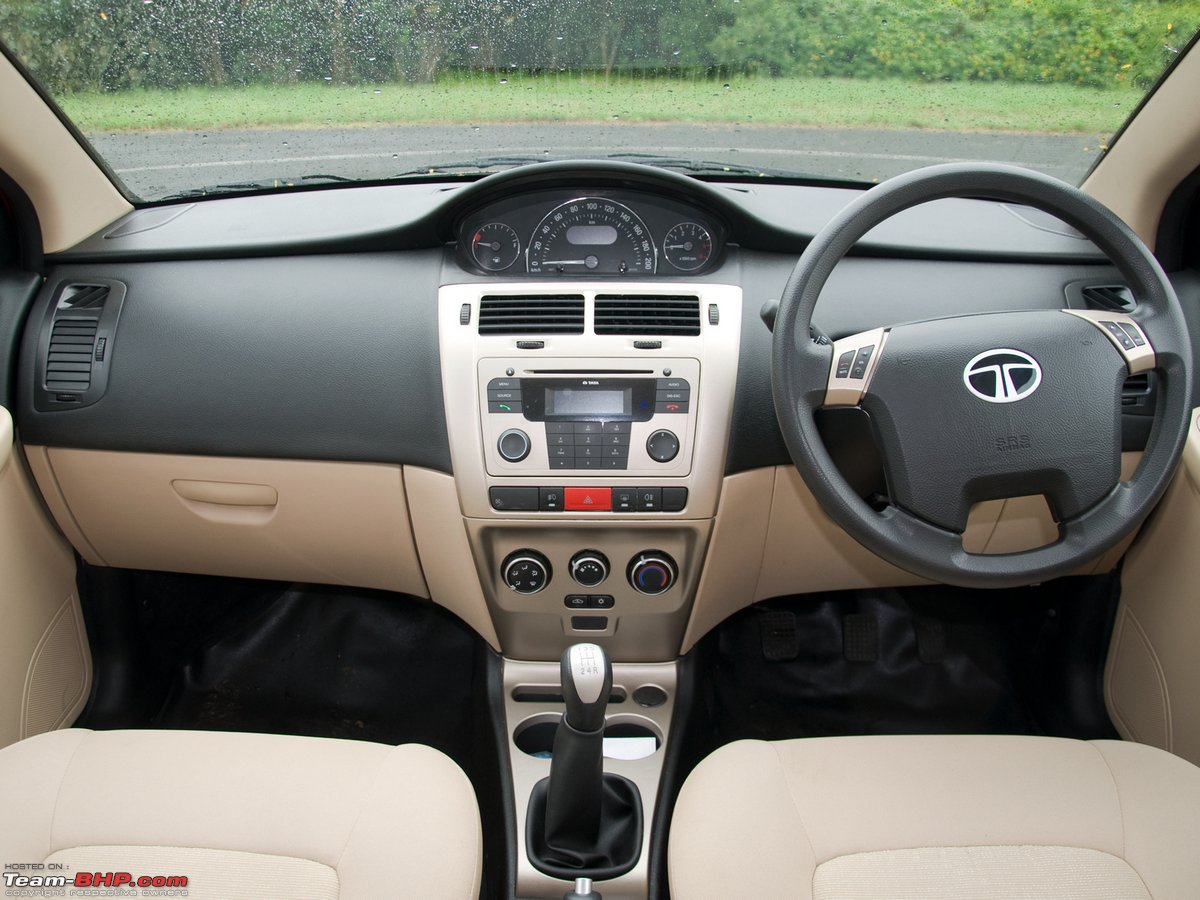
• New interiors look and feel much better in terms of overall quality
• Improved gearbox, light clutch and light steering make for effortless city driving
• Spacious interiors. Roomiest in the segment; beats some sedans from 2 segments up
• Absorbent, comfortable ride quality
What you won’t:
• Fit and finish need improvement. Exterior panel gaps are inconsistent too
• Soft suspension setup. Best driven sedately
• Centrally-mounted instrument cluster takes some getting used to
• Niggling issues & irritants persist (as reported by existing Vista owners)
• Tata’s after-sales-service remains a gamble
This report will only focus on the changes vis-à-vis the older Vista.
The Exterior Changes:
 |
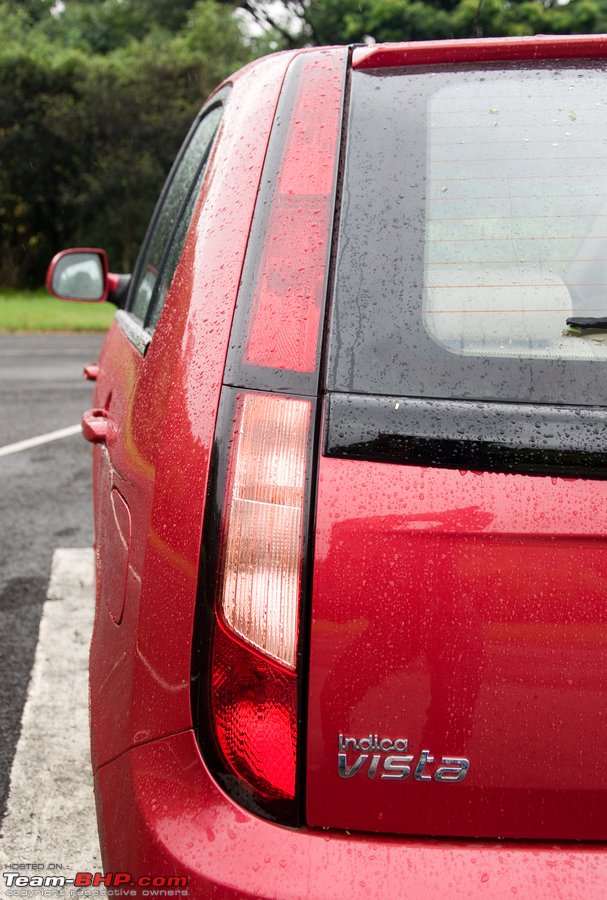
| The black strip appliqué improves the look of an otherwise bland rear |
 |
| New headlamp cluster, straight from the Manza |
 |
| New grille & larger logo on a mesh-net background |
 |
| Fog-lamps also get a chrome contour |
 |
| 175/65 R14 tyres on dual-tone alloy wheels, standard on the GZX / ZX |
 |
| Chrome garnish on window sills, door handles and rub-rails |
 |
| Spacing between the letters of the TATA logo has increased |
 |
| Expectedly, with the new branding, the Indica badge gets smaller now |
 |
| Dark outline of the tail-lights matches the black strip nicely |
The Interior Changes:
 |
| New dual-tone interior looks & feels good. Steering-mounted audio and bluetooth controls |
 |
| New electric switches replace the regular sliders for HVAC air-circulation modes. Only on the top variant |
 |
| Integrated audio system with Blue5 standard from the second variant (GLX / LX) onward |
 |
| 2-way adjustable lumbar support |
Summary:
Tata Motors has usually provided their cars with minor / major
modifications through the product life cycle, timed perfectly with
intensifying competition. The Indica Vista has had a reasonable market
run, thanks to the variety of engines that the hatchback is offered
with. Still,
too-similar-for-comfort looks to the 1st generation Indica, and the
Indica
branding, have kept high volumes away. With impending launches in the
B-segment space (new Swift, Liva diesel, Brio etc.), Tata decided to
give the Vista some enhancements, and boy they have played it well.
Unlike Maruti which refreshes their cars by replacing frosted lamps with
crystal clear ones and re-launches it (we buy them too!) as an
"all-new" car, the engineers at Tata Motors actually seem to have put
far greater effort into the revamp process.
 |
| Click on image to expand it |
The most significant change is the Manza look-alike front end. Although
Tata engineers say that it was a design change due to the market
response, I personally think that the Vista and Manza should have gotten
the same front end from the time of launch itself; just like the last
generation Indica and Indigo. Changes on the Vista’s face include
triple-barrel headlamps, a new grille with a larger company logo over a
mesh-net background and a new bumper with fog-lamps. The rear end has
also been slightly played around with. A glossy, hard plastic black
strip runs under the rear windscreen. At first glance, this strip looks
delicate & brittle, but it actually isn’t. The tail-lights have been
subtly smoked, providing a dark outline which goes well with the black
plastic strip. The Indian customer loves chrome and Tata knows this
well. Chrome runs all over the body of the face-lift Vista, including
the bumpers, door rub-rails, door handles, window sills and fog light
contours. Even though there is an ample amount of chrome usage, it does
not look ostentatious. The top-end variant gets 14 inch, multi-spoke
dual-tone alloy wheels. All these exterior changes make the Vista look
that much more mature.
Tata has shelved the older variant badges of Terra, Aqua, Aura and Aura
+. These have been replaced with LS, LX, VX and ZX for the diesel
models, and GLS, GLX, GVX and GZX for the petrol cars.
On the technical side, there have been some changes too, albeit they are
barely noticeable. The available engine options remain the same. All
test cars in this case had the Quadrajet diesel engine that produces
73.5 BHP @ 4000 rpm & 190 Nm of torque starting at 1,750 rpm. The
engine remains immensely sluggish upto 2000 rpm, at which point the
turbo kicks in. For a family hatch-back, the diesel Vista has decent
sprinting ability, thanks to the Fiat 1.3L engine. The car comfortably
cruises at triple digit speeds, keeping itself stable all the time. On
the flip side, the high turbo-lag negatively affects city driveability.
The rack & pinion steering (which was light to begin with) has been
worked upon to provide an
even lighter steering feel. The rear suspension springs have been slightly tuned to provide a softer ride.
There are some improvements on the inside too. The top two variants get
electric HVAC (in simpler words, this means that instead of a regular
slider for the air-circulation, there are two switches performing
exactly the task), adjustable lumbar support and "intelligent" rear
wiper (which activates as soon as you put the car in reverse gear + when
the front wipers are on) and tilt-steering. What comes as a nice
surprise is that Tata now offers a 2 DIN Music System with FM / MP3/ CD
with 4-speakers and 2 tweeters, AUX and USB port, Blue5 Bluetooth
Connectivity, steering mounted audio-controls and keyless entry right
from the LX / GLX variants. Definitely, a first in its class! The top
variant ZX / GZX get driver and passenger airbags, ABS with EBD (also
available in the VX / GVX) and 14 inch alloys wheels.
Two important things that I think Tata Motors should have added are a
dead pedal and height adjustable seat belts. Secondly, the lumbar
support just doesn't make the cut, and lacks the expected support to
your lower back.
Source:
Team-BHP Official Car Reviews