Friday, December 9, 2011

Tata Motors planning new Fuel Efficient and Powerful Engines for LCV

Tata ACE Zip


Tata Motors, India’s top commercial vehicle maker, is looking at replacing its older light commercial vehicle (LCV) engines with the new fuel efficient and powerful ones in order to retain dominance in the segment where competition is getting intense with new players joining in and older ones lining up newer models.

The company is currently working on a range of engines for its LCV and intermediate commercial vehicle (ICV) categories.

According to sources, Tata Motors has begun trials of the new engines and may showcase them during the Auto Expo in Delhi next month.The company currently sources its medium and heavy commercial vehicle (M&HCV) engines from Cummins India.

However, the LCV engines are being made by Tata Motors at its Pune plant. According to sources, the new LCV engines will have some input from Cummins India, but will be manufactured by Tata Motors solely.

“For LCVs, we are using our own engines. We are developing new engines to replace the current ones,” said Ravi Pisharody, president - commercial vehicles business unit at Tata Motors.

According to the company, the new 3-litre diesel engines will be launched within the next one year. Though the investment for upgradation of these engines is not known, sources said it is not very high.

Analysts said with competition getting intense, it was important for Tata Motors to retain its share in the LCV market. “Tata Motors is losing its share in the passenger vehicle segment. It is necessary for the company to take necessary steps to remain ahead in the LCV and M&HCV segments,” said an analyst with a domestic brokerage.Tata Motors currently has a market share of around 73% in LCVs. Mahindra & Mahindra has also emerged as a strong player in this segment, while new players like Ashok Leyland-Nissan and General Motors are looking to tap the potential.


Ashok Leyland recently launched its LCV Dost with its Japanese partner Nissan. The two companies plan to go aggressive with new launches. Also, General Motors and China-based SAIC will bring in their range of LCVs soon.

Pisharody said, “The new engines are more fuel efficient, technologically advanced and more powerful. We thought this is the right time to upgrade the engines”. LCV continues to be the best-performing segment for the company. Its year-to-date volumes grew 27% this year.

“There are a lot of opportunities in the light and small commercial vehicles. We are talking about slowdown, but in the last six months our growth in LCVs is almost similar to last year,” said Pisharody.

Source: DNA India

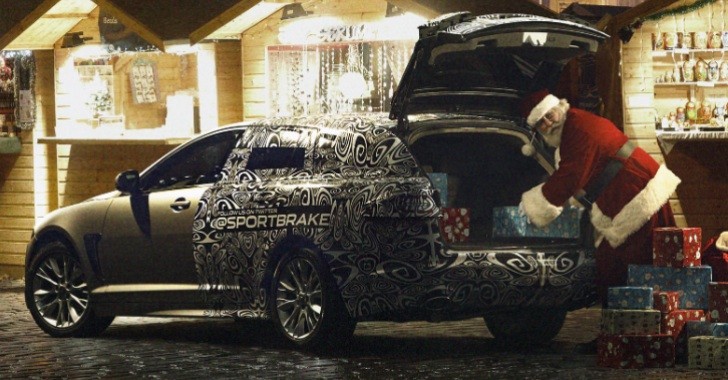
Santa Delivers 2011 Christmas Presents in Jaguar XF Sportbrake?


The whole idea if testing a car in secret is to hide it from the world until it’s ready, but Jaguar seems to think its brand new estate model, the first since the X-Type, is so good that they can show it before it’s completely uncovered. They seemed to have already found a marketing strategy for it - something about balance, according to their dedicated Twitter account.

The car maker quietly tweeted a teaser photo of none other than Santa Claus loading up his presents into the new Jaguar XF Sportbrake wagon, presumably because the massive loss of Arctic sea ice has left him without enough pasture for the reindeer.

The Sportbrake is definitely more style than capacity oriented. If you want space you’ll need to go the E-Class Estate route, but for style the Sportbrake looks very promising. We’re expecting Jaguar to offer the new 2.2 Diesel XF, 3.0 litre diesel and a range topping XFR Sportbrake, but there won’t be a 4WD Sportbrake until Jaguar launch the new XF in 2014. And we probably won’t get the official meat of detail on the Sportbrake range until just before Geneva in Spring 2012.


It’s not the first time Jaguar has touted the new wagon on Twitter—the car actually has its own feed called @Sportbrake. Until then, you can be sure his won’t be the last of the ‘spy’ shots of the XF Sportbrake with a touch of camouflage round the back and the @sportbrake handle on the side.

Thursday, December 8, 2011

Review: New Jaguar XF 2.2 turbo diesel

Jaguar XF 2.2 D


Looking at the Jaguar XF's speedo showing 110kmh doesn't compute when you glance across at the tacho registering a scant 1300rpm. But that's what the new turbo diesel four pot Jaguar XF 2.2 does on the highway. It cruises just above engine idle speed.

FRUGAL

Some cars would be humming away at 3000+rpm sucking fuel like there's no tomorrow. Not the XF 2.2 which is claimed to be capable of 5.4-litres/100km. We couldn't get that but saw a reliable 6.5-litres/100km with mixed driving.

Doesn't matter how you cut it, this sort of fuel economy from a 1700kg medium large luxury sedan car is damn impressive. Needless to say, the XF 2.2 is the most economical Jag ever made.

PERFORMANCE

And it goes pretty well too thanks to the 2.2-litre turbo-diesel engine made by PSA in Europe. PSA is an offshoot of Peugeot and supplies engines to BMW and Mini.

This engine is also in the Land Rover Freelander and new Range Rover Evoque. It's a good and capable of delivering a handy 140kW of power and 450Nm of torque.

Not as good as the Benz 2.1 turbo diesel rated at 150kW/500Nm but enough not to notice. There's an eight-speed auto driving the rear wheels with seamless precision and paddle shift if you want a sporty drive.

VALUE

The entry level XF Luxury hits the showroom at $78,900 plus on roads but start ticking the boxes for options and up it goes - rapidly. We drove the Premium Luxury model at $86,100 with more kit but you can still crank it up. Happy with the Luxury?

It gets you leather, Bluetooth phone and audio streaming, automatic dual climate control, air filtration, auto bixenon headlights, LEDs front and rear, a seven inch colour info ' touch screen and multi' steering wheel controls.

Other goodies include an electric park brake, pop up dash vents, pop up gear selector knob and rain sensing wipers. The XF was revised recently inside and out but still looks like.....an XF with XJ headlights.

THE DRIVE

The 2.2 is great to drive and you wouldn't know it was a four cylinder diesel except under hard acceleration because of low noise and vibration. It hauls the big sedan around with aplomb. Ride quality is supple and controlled and overall drive feel is positive.

DOWN SIDE

But it only gets a four star crash rating, has a space saver spare and there is some lag off idle when you punch the accelerator - waiting, waiting, whoosh.

The test vehicle developed an annoying frequency vibration in the front door area which would drive an owner nuts. We didn't `get' the engine stop/start system that seemed to have its own agenda. The boot opening is narrow.

VERDICT

It's up against some classy opposition in the BMW 520d, Benz E220CDi and Audi A6 2.0 front wheel drive - all around the same money. Hard call.....


JAGUAR XF 2.2L TURBO DIESEL
  • Prices: $78,900 (Luxury 2.2 turbodiesel), $86,100 (Premium Luxury 2.2 diesel), $84,990 (driveaway Luxury 2.2 white or black)
  • Warranty: 3 year/100,000 km
  • Service: 26,000km (diesel), 24,000km (petrol)
  • Safety: 4-star NCAP, 6 airbags, ABS, traction control, stability control
  • Engine: 5.4L litre, 4-cylinder turbodiesel, 140kW/450Nm
  • Transmission: 8-speed automatic, RWD
  • Thirst: 5.4 l/100km
  • CO2: 149g/km
  • Dimensions: 4961mm (L);1877mm (W);1460mm (H);2909mm(WB)

Source: Cars Guide

Hamann Range Rover 5.0i V8 Supercharged

Hamann Range Rover 5.0i V8 Supercharged


Just the Facts:
  • Hamann's package lifts output 20 horsepower, and increases torque by 25 pound-feet.
  • The aero kit includes a new front bumper with LED daytime running lights, fender extensions, side skirts, a rear bumper and a carbon-fiber roof spoiler.
  • Huge wheels and interior accessories are also part of the tune.
Tuning specialist Hamann has released a new upgrade program for the Range Rover with the supercharged 5.0-liter V8 power plant.

Hamann gives the luxury SUV a small power boost with an ECU remap that brings output to 530 horsepower and torque to 487 pound-feet. Two stainless-steel exhausts are offered — a standard setup with two twin-tipped exits and a central-mounted option.

The tuner installs an aerodynamics kit that consists of a front bumper with two LED daytime running lights, fender extensions, side skirts, a rear bumper and carbon-fiber roof spoiler. The side skirts add 2.3 inches of width to the front and 2.75 inches to the rear. This specific example also gets a set of 23-inch forged three-piece alloy wheels wrapped in tires sized 315/25; Hamann has a 22-inch set available as well.


Some of the additional interior goodies include a set of aluminum pedals, aluminum foot rest and floor mats. Hamann also offers a variety of emblems to dress up the exterior.

Source: Inside Line

Preview: Range Rover Evoque 2WD

Range Rover Evoque 2WD


Good

  • Stunning looks
  • High fuel economy and low CO2 emissions
  • Still a capable off-roader despite 2WD

Bad

  • 4WD model holds the edge in icy or very wet weather

Don't let its looks fool you, the Range Rover Evoque -- aka the baby Range Rover -- is a startlingly capable off-road vehicle. It's relatively small for a 4x4, but manages to keep pace with its bigger Freelander 2 and full-size Range Rover brothers off the beaten track. The Evoque puts them both to shame with its sporty, coupe-like road skills.

It'll come as no surprise to you that most drivers will never ask it to perform anywhere near its considerable off-roading limits. Most of the four-wheel drive technology actually hampers rather than helps its progress during ordinary city driving.

Luckily, Land Rover has been busy building a new Evoque designed specifically for the city. In doing so, it's ripped the heavy, complicated off-roading gubbins from under the car and built a two-wheel-drive model that better suits the needs of its hillock-dodging, cappuccino-loving target audience.

Land Rover took us to Austria, where we hopped in a prototype model and pointed it at the nearest mountain to find out if it's worth buying when it hits the streets in early 2012.

Range Rover Evoque 2WD

Two-wheel power

Land Rover's first step in creating a 2WD Evoque was to take a metaphorical axe to the thing. The rear half shaft? History. Rear prop shaft and drive units? Tossed aside. The power transfer unit? Forget about it -- it's gone for good. When you bury the go pedal, the only thing that moves are the Evoque's front wheels.

The biggest advantage gained in shedding its 4WD power system is a significant reduction in weight. By omitting the aforementioned components alone, Land Rover has been able to reduce the weight of Evoque by some 59.5kg, and the weight savings don't end there.

Land Rover has trimmed yet more fat by replacing the old metal bumpers, wheel arches and tailgate with new plastic ones. The bonnet, roof, front bumper beam and parts of the steering are constructed of aluminium; the cross-car beam, which sits behind the dashboard and provides rigidity, is made of magnesium alloy; and the windscreen is a svelte acoustic laminate.

All of this contributes to a total 75kg of weight saving. In total, the 2WD Evoque tips the scales at 1,600kg, which is an impressive 35 per cent lighter than a 2010 Range Rover Sport.

Range Rover Evoque 2WD


Fuel economy, road tax and emissions

In order to create the most efficient propulsion solution, Land Rover has paired the 2WD Range Rover Evoque with its weediest -- sorry, most efficient -- engine, the eD4 variant of its 150PS (147.9bhp) diesel unit. This 2.2-litre diesel lump, which also powers one of the 4WD models, is paired with a 6-speed manual transmission, as this is inherently lighter than an automatic box.

In all, the Evoque promises a combined fuel economy rating of 57.6mpg and CO2 emissions of 129g/km. That's a respectable 8mpg more and 20g/km less than is possible with a 4WD equivalent. That means its first year of road tax is free, with each subsequent year costing £95. Taxing the equivalent 4WD drive car costs £130 for the first year and £120 every year after that.

The Evoque achieves these numbers due to its use of several fuel-boosting gadgets. It's the first Range Rover to feature electronic power steering, which provides a 2 per cent fuel economy increase over traditional hydraulically-powered steering systems.

Range Rover Evoque 2WD

The 2WD Evoque also boasts stop-start, which shuts the engine down when the vehicle comes to a standstill, and fires it back into life when the clutch is depressed and the driver is ready to pull away. These systems are usually annoying at best and will make you want to punch a horse at worst, but this particular implementation works quickly and is relatively unobtrusive. Those who persist with it will be rewarded with a 3 per cent improvement in fuel economy.

A further 1.5 per cent gain in fuel economy is achieved through 'smart regenerative charging', which recovers energy when the vehicle decelerates. Sadly, this doesn't rely on a fancy KERS-like battery or flywheel to achieve the effect. Instead, the Evoque's power management system dynamically changes the resistance of the car's alternator -- the bit of the engine that converts mechanical energy to electrical in the form of alternating current.

Under acceleration, the alternator's resistance level is reduced so the engine doesn't have to work quite as hard to pull the car along. Under braking, that resistance is ramped up to harvest as much energy as possible, which is then used to power the vehicle's various electrical systems.

On paper, Mazda's prototype iELOOP regen system is superior as it promises a 10 per cent boost in economy, but every little helps.

Handling and performance

While its weight-saving and efficiency-boosting gadgets provide lower running costs and cleaner driving, the 2WD Evoque doesn't lose much ground in performance terms. It completes the 0-60mph sprint in 10.6 seconds and has a top speed of 112mph. The nearest equivalent 4WD car manages a 10.3 second 0-60mph time and a 112mph terminal velocity.

Range Rover Evoque 2WD

The loss of 4WD doesn't adversely affect the car's day-to-day handling either. On dry roads, it arguably feels more agile, which might be due to the lightweight aluminium roof and bonnet providing a lower centre of gravity and better balance.

The 2WD car has plenty of grip too. On dry surfaces, it impressed us hugely, following its 4WD sibling up seemingly insurmountable obstacles.

Range Rover Evoque 2WD
Its big brother leaves it for dead in icy or very wet conditions, but with a decent set of winter tyres, we can't imagine the 2WD Evoque getting stuck on tarmac, no matter how brutal the weather.

Outlook

Land Rover's primary mission in creating a 2WD Evoque was to eliminate inefficiencies. On this evidence, it appears to have succeeded. The 2WD Evoque is lighter, consumes less and is kinder to the environment than the 4WD models that came before it. All of that makes far more sense for the city-dwelling masses who would buy it.

The Evoque still manages to maintain the Range Rover's rough-riding spirit, however, facing up to rough terrain with aplomb when the going gets tough.

Source: CNET UK